


RULE OF LAW BREACH: Acting Judge Demonstrates Clear Lack of Impartiality
🇩🇰 Published: March 20, 2026 Contact:Hans-Henrik Juhl, Legal Process Consultant
LordBCSR.com , CVR 14523731 , E-mail: jur@lordbcsr.com
⚖️ Closure in Danish Court Case Highlights the Systemic Rule of Law Concerns.
Aarhus, Denmark – The Copenhagen City Court has formally closed case BS-62471/2025-KBH without substantive review of the underlying constitutional and human rights claims. Acting Assessor Line Elena Laustsen issued the final procedural decision, terminating the matter due to non-compliance with a mandatory attorney directive under the Danish Code of Judicial Procedure § 259(2). Line Elena Laustsen is listed as a funktionschef/konstitueret retsassessor (acting assessor/function head) at Københavns Byret, based on the court’s current organizational details. Such cases—particularly those involving constitutional matters or potentially higher-stakes civil/human rights claims—typically require a collegial bench of at least three judges (often one professional judge and two lay assessors, or three professional judges depending on the case category and complexity under Danish procedural rules), rather than a single acting assessor handling purely procedural terminations.
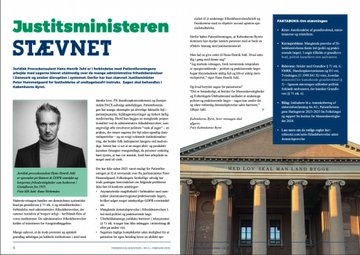
FOREBYGGELSESAVISEN – NR. 6- FEBRUARY 2026 — Patientforeningen.dk
The lawsuit sought to challenge systemic administrative deprivations of liberty affecting psychosocially disabled individuals, including alleged violations of the Danish Constitution lex superior § 71(6) (right to judicial review of deprivation of liberty) and broader principles of separation of powers and judicial independence under §§ 3, 27, and 64. Despite repeated objections concerning technical barriers in the court’s digital portal (minretssag.dk), incomplete evidence registration, and calls for multi-judge consideration (RPL § 9(2)), the court did not address these substantive issues.
This procedural closure perpetuates a legacy of historical eugenics in Denmark and the Unity of the Realm, where institutionalization of people with disabilities—rooted in mid-20th century population control measures—continues through what critics describe as “law enforcement theater.” It embodies a Bourdieusian habitus of exclusion and embodied disability, prioritizing administrative efficiency and public job creation over individual rights.
This is not an isolated case.
It echoes patterns observed in Patientforeningen.dk’s similar cases at Aarhus City Court in 2023-24 and the surprising 2021 Supreme Court ruling that effectively set aside provisions of the Constitution §§ 3, 27, 61, 64 and 71(6) in contexts involving administrative power-abuse over individual liberty.
Chair; Niels Jørgen Langkilde, Patientforeningen.dk
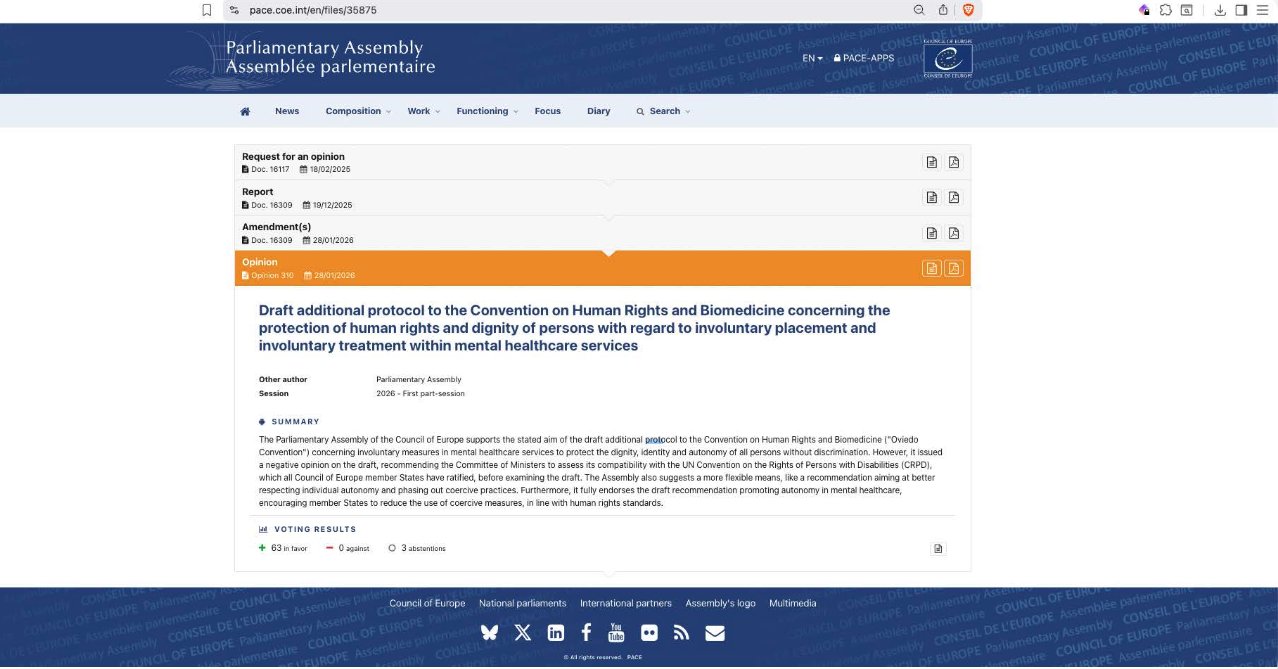
26.01.2026 Opinion 310 – Opinion – PACE Council of Europe
Form Over Function: Denmark’s Selective EU Engagement
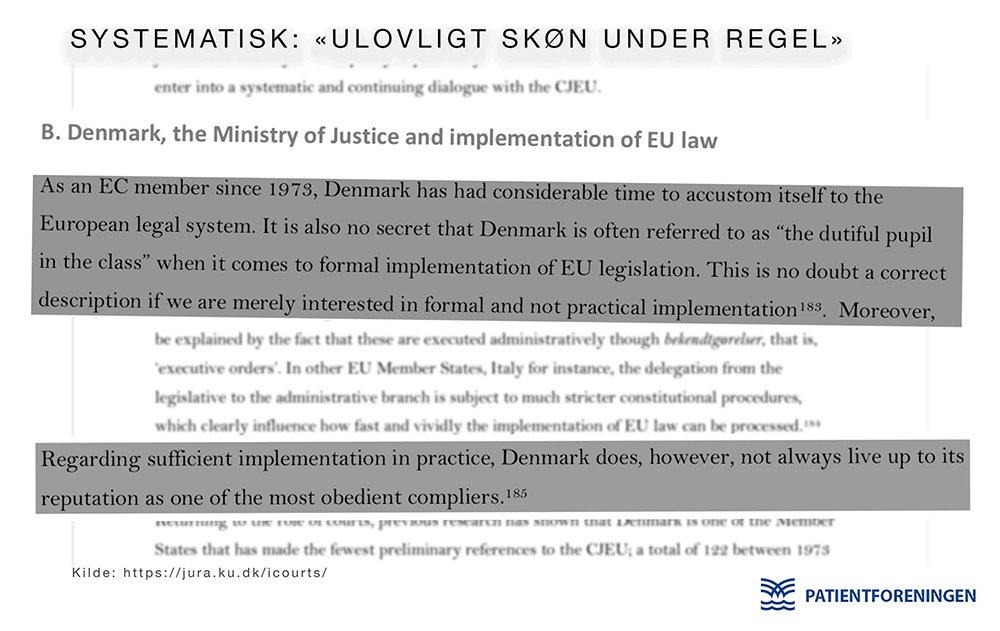
As noted by Professor Marlene Wind in her working paper “The Hesitant European”, Denmark is often referred to as “the dutiful pupil in the class” when it comes to formal implementation of EU legislation. Yet this image belies a more hesitant or procrastinating reality in practical application and judicial engagement. Denmark has made only 122 preliminary references to the Court of Justice of the European Union (1973–2019), and significant resources are invested in projecting an image of exemplary compliance while deeper systemic challenges remain unaddressed
Marlene Wind is a professor specializing in European politics, law, and the interplay between politics and international courts. She is affiliated with iCourts (Centre of Excellence for International Courts) at the Faculty of Law, University of Copenhagen, Denmark.
False Compliance, Real Consequences The closure of BS-62471/2025-KBH reveals a troubling paradox: While Denmark formally upholds European and international human rights standards, the persistent use of procedural barriers to avoid substantive examination of systemic violations—particularly in areas with historical and ongoing human rights sensitivities such as eugenics—undermines the rule of law and Denmark’s obligations under the European Convention on Human Rights, specifically Articles 6 (fair trial), 8(2) (foreseeable rule of law criteria), and 13 (effective remedy)
Peterson’s Paradox: Münchausen Welfare Exposed In the spirit of Oscar Wilde’s The Picture of Dorian Gray, Denmark—echoing Jordan Peterson’s critique of Scandinavian gender paradoxes—presents a polished facade of exemplary compliance and virtue on the international stage, while the underlying reality remains hidden: procedural barriers born of immature, feminized taboos and touch-aversion, akin to a welfare state’s Münchausen by proxy clinging to eugenic legacies. This sidesteps EU subsidiarity (TEU 5.3) and Nuremberg Code principles on consent and human experimentation.
For further information or documentation: Follow developments via LordBCSR.com or x.com/LordBCSR
Quotes from Hans-Henrik Juhl:
“In authorities’ Munchausen by proxy grip, eugenic legacies induce societal ‘diseases’ for control, hidden under feminized taboos that evade ethical reckoning.”
“Procedural dismissals may preserve order in the short term, but they erode trust when they systematically block scrutiny of fundamental rights.”
“A justice system that avoids confronting its own historical and ongoing shortcomings risks losing legitimacy in the eyes of those it is meant to protect.”